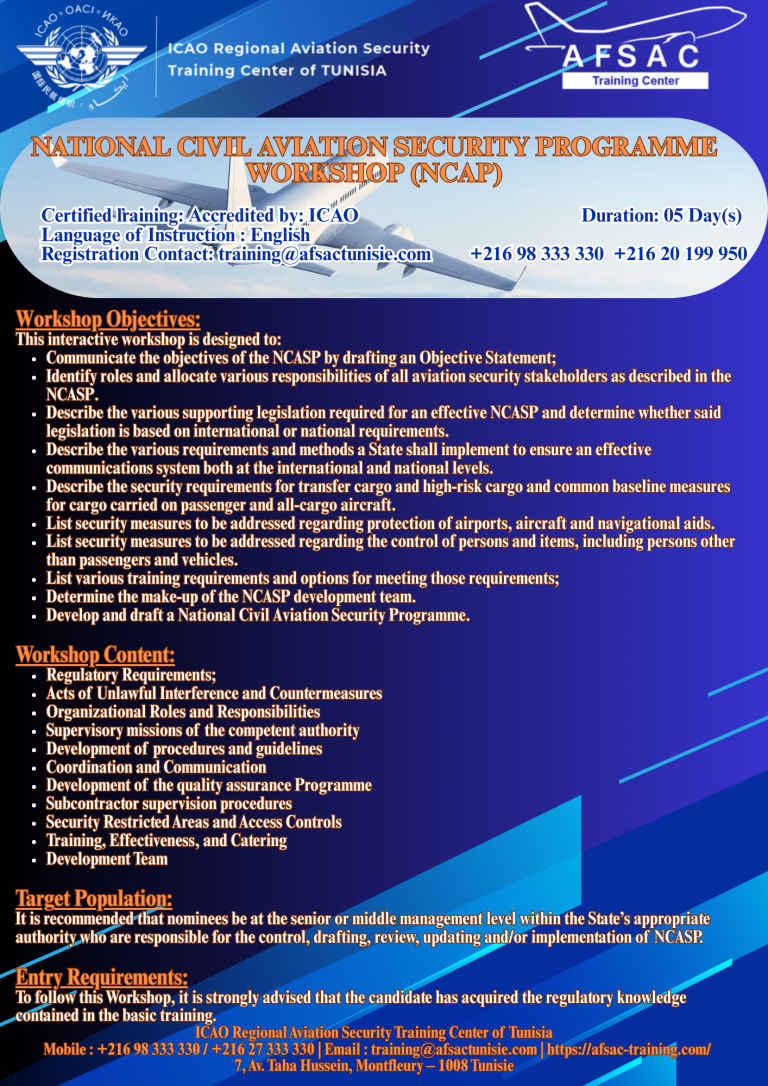
This interactive workshop enables participants to communicate the objectives of the National Civil Aviation Security Programme (NCASP), allocate the responsibilities of aviation security stakeholders, and develop and draft a National Civil Aviation Security Programme in accordance with ICAO requirements.
Learning objectives
Communicate the objectives of the NCASP by drafting an Objective Statement.
Identify roles and allocate the responsibilities of all aviation security stakeholders as described in the NCASP.
Describe the supporting legislation required for an effective NCASP and determine whether it is based on international or national requirements.
Describe the requirements and methods a State shall implement to ensure an effective communications system at the international and national levels.
Describe the security requirements for transfer and high-risk cargo and common baseline measures for cargo carried on passenger and all-cargo aircraft.
List security measures regarding the protection of airports, aircraft and navigational aids.
List security measures regarding the control of persons and items, including persons other than passengers and vehicles.
List training requirements and options for meeting them.
Determine the make-up of the NCASP development team.
Develop and draft a National Civil Aviation Security Programme.
Structure
Module 0: Regulatory Requirements
Module 1: Acts of Unlawful Interference and Countermeasures
Module 2: Organizational Roles and Responsibilities
Module 3: Supervisory missions of the competent authority
Module 4: Development of procedures and guidelines
Module 5: Coordination and Communication
Module 6: Development of the quality assurance Programme
Module 7: Subcontractor supervision procedures
Module 8: Security Restricted Areas and Access Controls
Module 9: Training, Effectiveness, and Catering
Module 10: Development Team
Target audience
It is recommended that nominees be at the senior or middle management level within the State’s appropriate authority who are responsible for the control, drafting, review, updating and/or implementation of the NCASP.
Prerequisites
It is strongly advised that the candidate has acquired the regulatory knowledge contained in the basic training.